Guide
Roman numerals in names, events and everyday life
Two thousand years on, Roman numerals still mark things that are meant to feel important or permanent. Here's where you'll find them, and how to read each one.
Kings, queens and popes
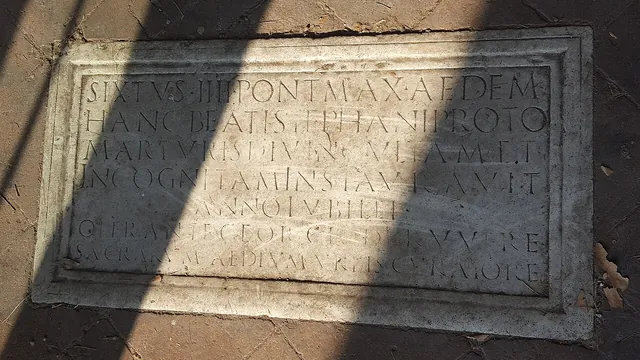
Rulers who share a name are numbered in order: Henry VIII, Louis XIV, Elizabeth II, Charles III. Popes are numbered the same way: John Paul II, Benedict XVI. You say them as ordinals, "Henry the Eighth", even though the numeral is just VIII.
Families sometimes do the same: a son named after his father and grandfather may be John Smith III.
Sport
- The Olympics are numbered by Olympiad. The Paris 2024 Summer Games were officially the Games of the XXXIII Olympiad (33rd). The Winter Games have their own count: Milano Cortina 2026 is the XXV Olympic Winter Games.
- The Super Bowl is famous for its numerals. The one exception was Super Bowl 50 in 2016: the NFL felt a lone L didn't work as a logo. The numerals came back the next year with Super Bowl LI.
Music
Musicians use Roman numerals to name chords by their position in a key. In C major, I is C, IV is F and V is G, so the classic three-chord song is "I–IV–V" in any key. Capitals mean major chords and lowercase mean minor: vi is A minor in C major.
Science and medicine
- Chemistry: the charge on some metals is shown in brackets, as in iron(III) oxide, which is rust, or copper(II) sulfate.
- Anatomy: the twelve cranial nerves are numbered I to XII.
- Heart tracings (ECGs) label three of their leads I, II and III.
Books, plays and outlines
- Front pages of many books (the preface and contents) are numbered in lowercase: i, ii, iii, iv. The main text then starts again at 1.
- Plays are divided into acts and scenes, often written Act III, Scene ii.
- Outlines and legal documents use Roman numerals for top-level sections: I, then A, then 1, then a.
- Volumes and chapters of long works are often numbered this way too.
Films, wars and anniversaries
- Sequels: The Godfather Part II, Rocky IV, Star Wars: Episode IV – A New Hope.
- World wars: World War I and II.
- Copyright years in credits, such as MCMLXXXV. How to read them fast.
Stone, metal and ink
Roman numerals suit things meant to last. Foundation stones and public buildings often carry their year in numerals. The tablet held by the Statue of Liberty reads JULY IV MDCCLXXVI: 4 July 1776. Clock faces use them, usually with IIII for four. And people choose them for engravings and date tattoos for the same reason: they look as if they've always been there.