Guide
Why clocks use IIII instead of IV
Ask anyone how to write four in Roman numerals and they'll say IV. Yet look at almost any clock with Roman numerals and you'll see IIII. It's called the clockmaker's four, and nobody knows for certain how it started. These are the explanations people give most often.

It balances the dial
This is the most practical reason. On a dial, IIII sits opposite VIII, the heaviest numeral on the face. IIII has four strokes and VIII has four characters, so the two sides look evenly weighted. IV would leave the right-hand side looking light.
There's a neater pattern too. With IIII, the first four hours use only I, the next four (V to VIII) all start with V, and the last four (IX to XII) all include X. The dial falls into three tidy groups.
The Romans wrote it that way too
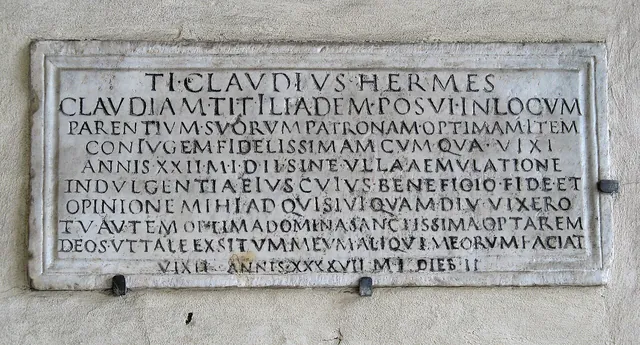
The strict rule that four must be IV came much later. Roman inscriptions often use additive forms such as IIII and VIIII alongside subtractive ones. Early clockmakers were following a long tradition rather than breaking a rule. More on how subtraction works.
It made casting easier
A popular story says numerals were cast in metal from a set of moulds. With IIII, the twelve hours need exactly twenty I's, four V's and four X's, which divide neatly into four identical sets: one mould could be used four times. With IV, the counts don't divide so evenly. The arithmetic is right; whether clockmakers actually worked this way is less certain.
A legend about Jupiter
In Latin, Jupiter was written IVPPITER or IVPITER, starting with the letters IV. A well-known legend says the Romans avoided IV out of respect for the god. It's a good story, but there's little evidence for it.
Not every clock follows the rule
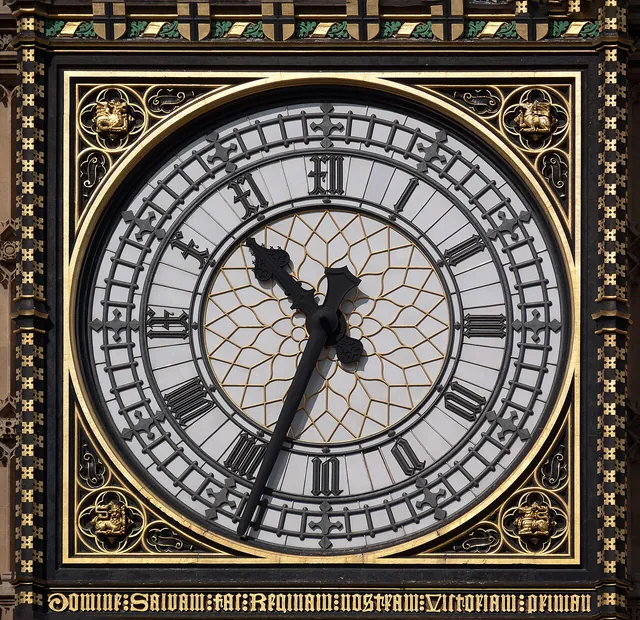
The clockmaker's four is a tradition, not a law. The dials of the Great Clock of Westminster, the clock in the Elizabeth Tower usually called Big Ben, show IV. Many modern watches use IV too. Both are correct; IIII simply looks more like a clock to most people.
Which should you use?
- For a clock face, including a clock tattoo, IIII looks traditional and balanced.
- For anything else, such as a date, a number or a year, use IV. IIII outside a clock face looks like a mistake.
The clock face generator uses IIII by default and lets you switch to IV, so you can compare them on the same dial.