Guide
How Roman numerals work
Roman numerals look complicated, but they follow a handful of rules. Once you know them, you can read any numeral from I to MMMCMXCIX.
The seven letters
| Letter | I | V | X | L | C | D | M |
|---|---|---|---|---|---|---|---|
| Value | 1 | 5 | 10 | 50 | 100 | 500 | 1000 |
Notice the rhythm: each "one" (I, X, C, M) is ten times the one before, and each "five" (V, L, D) sits halfway between. C and M also match the Latin words centum (hundred) and mille (thousand), which makes them easy to remember.
Adding letters together
Write the largest values first and add them up. VIII is 5 + 1 + 1 + 1 = 8, and MDCLXVI uses every letter once, largest to smallest: 1,000 + 500 + 100 + 50 + 10 + 5 + 1 = 1,666.
Two limits keep numerals short: I, X, C and M can repeat up to three times in a row, and V, L and D are never repeated, since VV would just be X.
Subtraction: the six pairs
To avoid writing four of the same letter, a smaller letter placed before a larger one is subtracted from it. Only six pairs are used:
| Pair | Means | Instead of |
|---|---|---|
| IV | 5 − 1 = 4 | IIII |
| IX | 10 − 1 = 9 | VIIII |
| XL | 50 − 10 = 40 | XXXX |
| XC | 100 − 10 = 90 | LXXXX |
| CD | 500 − 100 = 400 | CCCC |
| CM | 1,000 − 100 = 900 | DCCCC |
The rule behind the list: only I, X and C can be subtracted, and only from the next two letters up. I goes before V or X, X before L or C, and C before D or M. That's why 49 is XLIX (40 + 9) and not IL, and 1999 is MCMXCIX, not MIM.
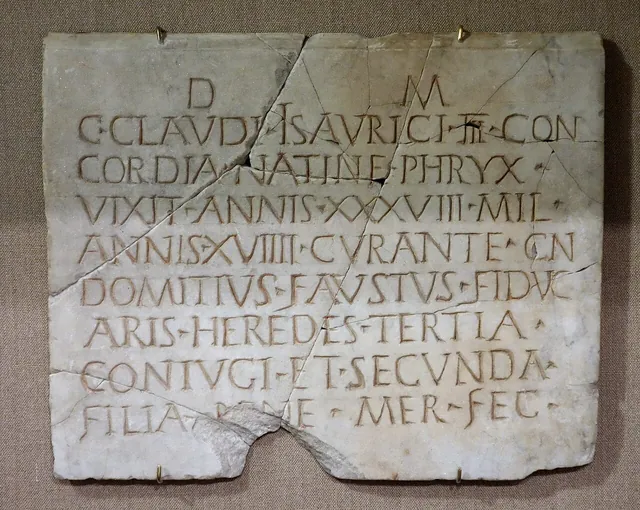
The Romans themselves weren't strict about this. Inscriptions mix IIII with IV and VIIII with IX. The tidy rules taught today were settled much later, which is why clock faces still often show IIII.
Reading a numeral, step by step
Go left to right. If a letter is smaller than the one after it, subtract it; otherwise add it. Take MCMXCIV:
- M is followed by a smaller letter, so add 1,000.
- C is followed by M, which is larger, so subtract 100. Then add M: 900 so far for this pair.
- X is followed by C, so subtract 10, then add 100: 90.
- I is followed by V, so subtract 1, then add 5: 4.
- Total: 1,000 + 900 + 90 + 4 = 1994.
Writing a number, step by step
Split the number into thousands, hundreds, tens and ones, write each part on its own, then join them. For 2,026: 2,000 is MM, 0 hundreds is nothing, 20 is XX and 6 is VI, giving MMXXVI. Each part only ever uses one of ten patterns:
| Digit | Ones | Tens | Hundreds |
|---|---|---|---|
| 1 | I | X | C |
| 2 | II | XX | CC |
| 3 | III | XXX | CCC |
| 4 | IV | XL | CD |
| 5 | V | L | D |
| 6 | VI | LX | DC |
| 7 | VII | LXX | DCC |
| 8 | VIII | LXXX | DCCC |
| 9 | IX | XC | CM |
The tens and hundreds columns are the ones column with bigger letters swapped in. Learn one column and you know all three.
Numbers above 3,999
Under the modern rule that M repeats at most three times, the largest numeral written without extra marks is 3,999, MMMCMXCIX. For bigger numbers, today's usual convention is a bar drawn over letters (a vinculum), which multiplies them by 1,000. It's mostly a medieval and modern habit; Roman writers used several other marks too. So V is 5,000 and XCC is 10,200. The converter handles these up to 3,999,999; type the barred part in brackets, like (X)CC. More on big numbers.
Why there's no zero
Roman numerals were for counting and recording amounts, and you don't need a symbol to count nothing. Because each letter has a fixed value wherever it sits, there's also no need for a placeholder, the job zero does in 2026. Centuries later, medieval scholars working on calendars wrote the word nulla (none) where a zero was needed. That's also why a date tattoo can't shorten 2000 to '00.
Where you'll see them today
- Clock and watch faces, often with IIII for four. Why IIII?
- Copyright years in film and TV credits, such as MCMLXXXVIII for 1988. How to read them fast.
- Monarchs and popes: Elizabeth II, Charles III, Henry VIII. More everyday uses.
- Book prefaces and chapters: front pages are often numbered in lowercase (i, ii, iii).
- Major events, from sporting finals to anniversaries.
- Tattoos and engravings of meaningful dates. Our date tattoo guide.